

$15.00 $150.00
Back
 Add to wishlist
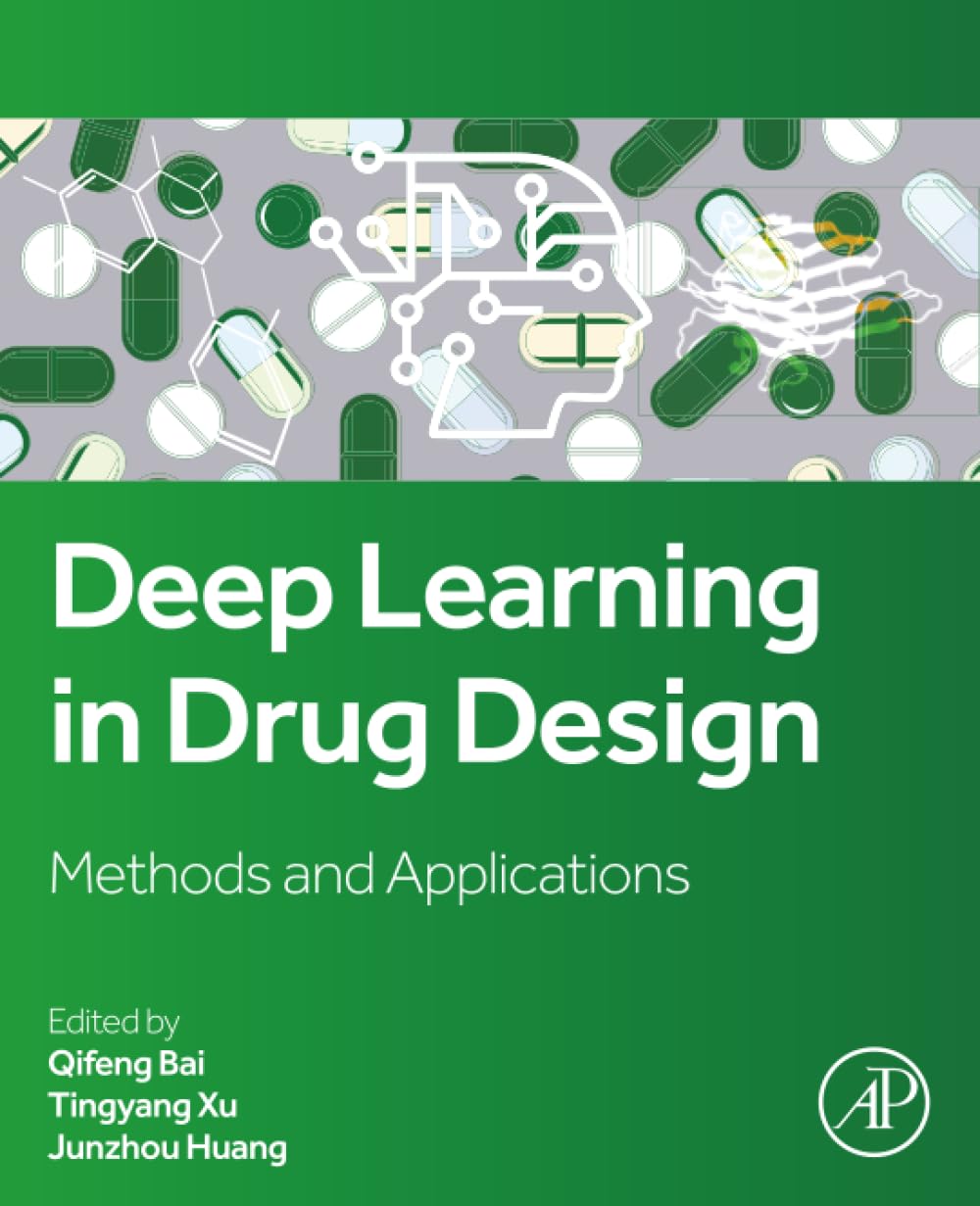
Deep Learning in Drug Design: Methods and Applications (Original PDF from Publisher)
$15.00 $150.00
- Format: Publisher PDF
- Posted Date: 22 Apr 2026
- Posted By: AfkEbooks
Specification
| Published Year | 2025 |
|---|---|
| Language | English |
| Publisher | Elsevier |
| Edition : | 1 |
| Format : | Publisher PDF |
| File Size : | 17.7 |
| ISBN : | 9780443329081, 9780443329098 |
Description
by Qifeng Bai PhD (ed.), Tingyang Xu PhD (ed.), Junzhou Huang PhD (ed.)
Deep Learning in Drug Design: Methods and Applications summarizes the most recent methods, and technological advances of deep learning for drug design, which mainly consists of molecular representations, the architectures of deep learning, geometric deep learning, large models, etc., as well as deep learning applications in various aspects of drug design. This book offers a comprehensive academic overview of deep learning in drug design. It begins with molecular representations, CNNs, GNNs, Transformers, generative models, explainable AI, large models, etc. Next, it covers deep learning applications like protein structure prediction, molecular interactions, ADMET prediction, antibody design, and so on. Finally, a separate chapter is dedicated to the introduction of the ethics and regulation of artificial intelligence in drug design. This book is ideal for readers aiming to learn and implement deep learning methods and applications in drug design and related fields.
Deep Learning in Drug Design: Methods and Applications is particularly helpful to undergraduate, graduate, and doctoral students in need of a practical guide to the principles of the discipline. Established researchers in the area will benefit from the detailed case studies and algorithms presented.
Deep Learning in Drug Design: Methods and Applications is particularly helpful to undergraduate, graduate, and doctoral students in need of a practical guide to the principles of the discipline. Established researchers in the area will benefit from the detailed case studies and algorithms presented.
- Introduces the basic theories, current methods, and principles of deep learning for drug design
- Presents the major application fields of drug design based on deep learning including protein folding, retrosynthesis prediction, molecular generation, molecular docking, and ADMET prediction, among others
- Details explainable artificial intelligence for drug design models
DETAILS
-
Publisher
-
Language
-
ISBN9780443329081, 9780443329098
-
Original Link